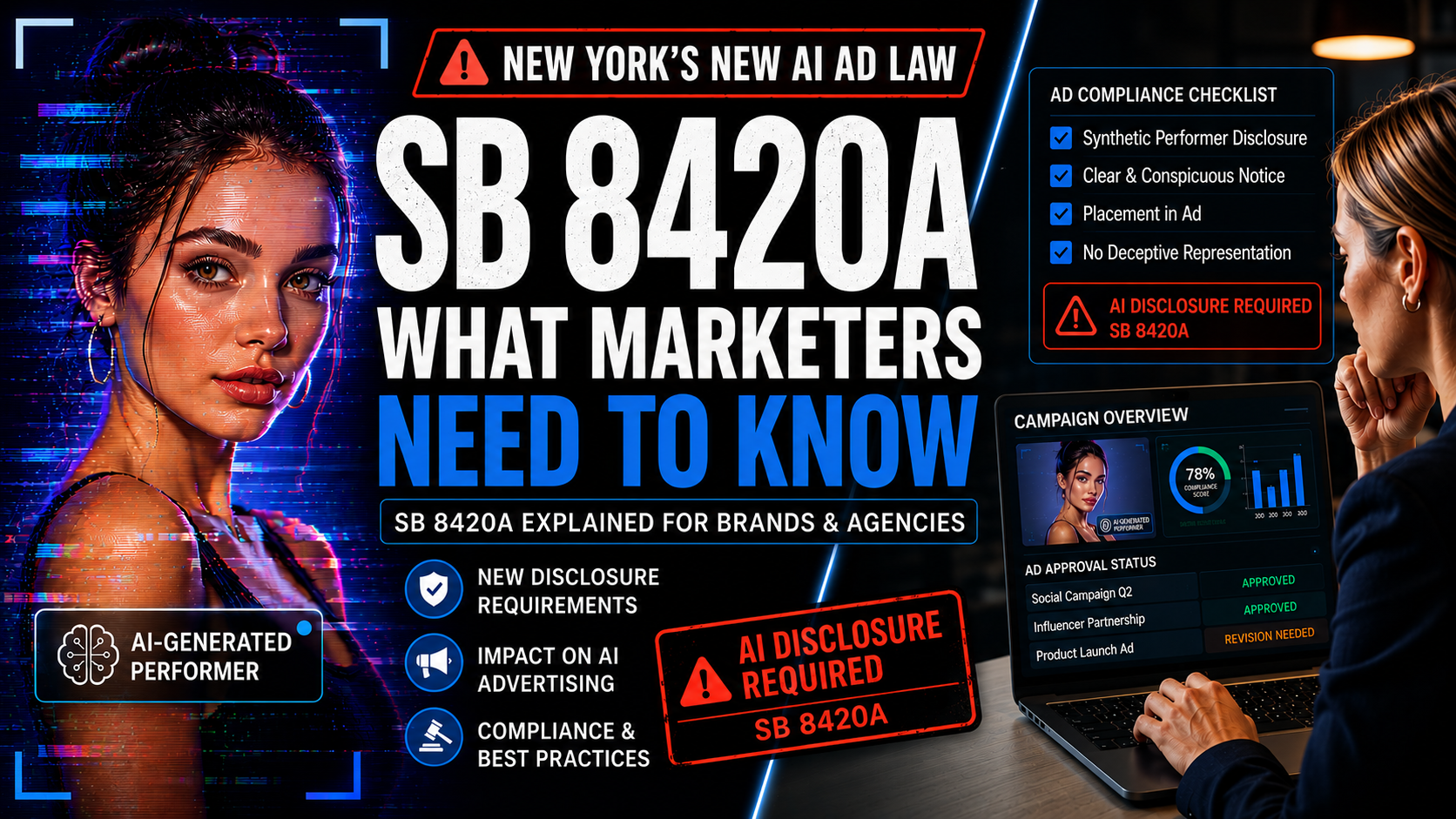
Most marketers are using AI to move faster. Faster to create, faster to test, faster to scale. But New York’s SB 8420A is the kind of law that reminds everyone that speed without clarity can get expensive.
If your ads use AI-generated people, AI-altered faces, or synthetic spokespersons, this law may require a conspicuous disclosure when those ads are distributed in New York. It is not a ban on AI in marketing. It is a transparency rule aimed at helping people understand when the “person” in an ad is synthetic.
And honestly, that is the part marketers need to pay attention to. This law is less about the novelty of AI and more about trust, transparency, and not accidentally building a compliance problem into your creative pipeline.
What SB 8420A actually does
SB 8420A is New York’s Synthetic Performer Disclosure Law. In plain English, it says that if an advertisement uses a synthetic performer, the advertiser must conspicuously disclose that fact if the advertiser has actual knowledge of the synthetic performer’s inclusion. The law does not spell out the exact language, placement, or size for the disclosure.
A synthetic performer is generally described as a digitally created asset using generative AI or software algorithms intended to create the impression of a human performer who is not recognizable as an identifiable natural person. That means the law is aimed at AI-generated or heavily AI-altered humanlike performers in ads, not every possible use of AI behind the scenes.
The law was signed in December 2025 and takes effect on June 9, 2026. Civil penalties can reach $1,000 for a first violation and $5,000 for subsequent violations.
Why marketers should care
This is not just a legal side note. It changes how campaigns get approved, how creative gets produced, and how teams think about AI in public-facing content. If your brand runs ads on social media, in paid video, or through marketplace channels, New York now becomes a state where AI use deserves more scrutiny.
A lot of people hear “New York law” and immediately think, “Great, not my problem.” Not so fast. The law is relevant if your ad is distributed in New York, even if your company, agency, or seller account is based somewhere else.
That matters because digital campaigns rarely stay inside neat little state borders. If your paid social campaign, ecommerce ad, or marketplace creative can reach New York consumers, this law deserves a spot on your radar.
What if your business is outside New York?
This is where marketers can get tripped up. The law is tied to advertising distributed in New York, not just companies physically located there. So a California brand, a Texas agency, or an out-of-state seller could still face this issue if New York consumers see the ad.
In plain English, geography does not save you if distribution brings you into the state. If New York is one of the places your ad can appear, the safer move is to review any ad that uses an AI-generated or substantially AI-altered humanlike performer.
This is especially important for brands running broad digital campaigns with little state-by-state customization. When targeting is wide, compliance has to be wide too.
What counts as a synthetic performer
This is the part marketers should really understand, because the phrase sounds technical but the concept is pretty practical. A synthetic performer is an AI-created humanlike presence in an ad — a digital person, a fake spokesperson, or a performance altered enough to create the impression of a human performer who is not an identifiable natural person.
That could include an AI avatar delivering a product pitch, a virtual brand ambassador, or a highly realistic synthetic presenter used in ad creative. What matters is not whether AI touched the workflow somewhere in the background, but whether the final ad presents a synthetic humanlike performer to the audience.
So if AI helped brainstorm the campaign, clean up the script, or speed up post-production, that alone does not appear to be the issue this law is targeting. The issue is the final ad content and whether it includes a synthetic performer.
What is exempt
Not every AI-related campaign gets swept up here, which is good news for marketers who use AI in more limited ways. The law does not apply to audio-only advertisements, and it excludes situations where AI is used solely for language translation of a human performer.
It also exempts advertisements and promotional materials for expressive works such as motion pictures, television programs, streaming content, and video games when the use of the synthetic performer in the ad is consistent with its use in the underlying work. That means a movie trailer or game promo may be treated differently from a standard commercial advertisement.
There is also protection for media outlets and platforms that merely publish or disseminate ads, and the law does not alter Section 230 protections for interactive computer services regarding third-party content. That point matters because the advertiser’s own obligations are not erased just because a platform carries the ad.
What about AI ads on Amazon?
Amazon is a channel, not a shield. If an Amazon ad uses a synthetic performer and that ad is distributed in New York, the New York disclosure rule can still matter. The law’s focus is on the advertising content and where it is distributed, not on whether the ad appears on a marketplace platform.
That includes the kinds of creative ecommerce brands increasingly use across retail media, such as AI-generated spokesperson videos, avatar-style product explainers, or highly realistic synthetic humans in ad creative. The legal question is still the same: what the consumer sees, where the ad appears, and whether the ad presents a synthetic performer without a conspicuous disclosure.
This is the part that trips people up. Platform approval is not the same thing as state-law compliance. If an Amazon ad passes a platform review but reaches New York consumers without the required disclosure, that does not automatically make it compliant.
The compliance risk
Yes, there are civil penalties, and those are enough to get attention. But the bigger risk is often operational and reputational. Nobody wants to pull a campaign late, patch disclosures after launch, or explain why the brand thought a fake person in an ad did not need transparency.
That is why this law should be treated as a workflow issue, not just a legal issue. The smartest move is to build the check into your creative process before the ad is approved, trafficked, or distributed.
If your business uses agencies, freelancers, production partners, or AI tools, the review process needs to happen upstream. Commentary on the law specifically warns businesses advertising in New York to review their own practices and those of third parties that create ads for them.
How marketers should prepare
Start with an audit of every place your team uses AI in advertising. Look at paid social, video ads, marketplace campaigns, landing page media, and branded content that features a face, voice, or human presenter. If the final asset looks like a person and AI helped create that person, pause and review.
Then add one simple approval question to your workflow: “Does this ad contain a synthetic performer?” If the answer is yes, New York distribution should trigger a disclosure review. That one question can save a lot of chaos later.
It also helps to assign ownership. Creative teams should know when to flag an asset, legal or compliance should know what to review, and media teams should know which placements might require state-specific handling. That is how you keep the process clean without making the whole thing feel corporate and clunky.
FAQ
What is New York SB 8420A?
SB 8420A is a New York law requiring advertisers to conspicuously disclose the use of a synthetic performer in advertising when the advertiser has actual knowledge of that synthetic performer’s inclusion.
Does the law ban AI in marketing?
No. It does not ban AI use in marketing. It focuses on disclosure when an ad uses a synthetic performer.
What counts as a synthetic performer?
A synthetic performer is a digitally created asset using generative AI or software algorithms intended to create the impression of a human performer who is not recognizable as an identifiable natural person.
Do all AI-powered ads need a disclosure?
No. The issue is not every use of AI in the creative process. The key issue is whether the final ad includes a synthetic performer.
Does this apply if my business is outside New York?
Yes, potentially. If your ad is distributed in New York, the law may matter even if your company, agency, or seller account is based elsewhere.
What matters more: where my business is located or where the ad is shown?
For practical compliance, where the ad is shown matters more. If New York consumers can receive the ad, that is the safer trigger for review.
Are there any exemptions?
Yes. Audio-only ads are excluded, AI used only for language translation of a human performer is excluded, and certain ads for expressive works like films, TV, streaming content, and video games are exempt in specific circumstances.
What about AI ads on Amazon?
Amazon does not create a carveout from the law. If an Amazon ad uses a synthetic performer and is distributed in New York, SB 8420A may still apply.
If Amazon approves my ad, am I automatically compliant?
No. Platform approval is not the same as compliance with state law. Advertisers still need to assess whether New York’s disclosure requirement applies.
What should marketers do now?
Audit ad creative, flag any AI-generated humanlike performers, identify whether those ads can be shown in New York, and create a disclosure review step before launch. Businesses should also review the practices of agencies and third parties creating ads on their behalf.
