You hit publish. The episode is live. Now what?
If you've been podcasting for any length of time, you know this moment well. You send your guest a DM that goes something like: "Hey! The episode is up — here's the link, feel free to share!" And then you wait. Maybe they post something. Maybe they don't. Maybe they share the wrong link. Maybe they just... disappear.
It's not that guests don't want to promote. It's that no one made it easy for them. And more than that — nobody built a system to keep the relationship alive after the recording ends.
That's what my friend Junaid Ahmed figured out. He's a veteran UX designer, photographer, videographer, podcast host, and someone who has spent 25 years simplifying complex workflows. He's interviewed over 700 guests across hundreds of episodes. And after doing it for eight years, he noticed the same thing every single time.
"The episode gets published, everyone moves on, and all the value quietly disappears," he told me on stream. "It's not because people didn't care. It's because podcasting was built around publishing content — mirroring what radio and television were doing. But it wasn't maintaining relationships."
So he spent four years researching it — interviewing over 100 podcast hosts and 15 agency owners — and then built the solution himself in five months.
He calls it PodGlue. I called it the Infinity Gauntlet of podcasting. We were both right.
The Philosophy First: Podcasts Are Relationship Engines, Not Content Machines
Before I show you the features, you need to understand what makes PodGlue fundamentally different from every other podcast tool out there.
Junaid coined a new term while building it: PRM. Podcast Relationship Management. He even wrote a book on it.
“Podcasts are actually not content machines. They’re relationship engines — if you use them the right way.”
That philosophy is baked into every single feature. PodGlue isn't trying to help you publish faster or clip more reels. It's trying to make sure that every conversation you have keeps working for you long after you hit stop on the recording. He literally describes it as "the relationship-focused operating system for a podcaster."
With that framing, here's what it actually does.
Feature #1: The Forge — Your Podcast CRM
This is the foundation everything else is built on, and the reason PodGlue exists at all.
The Forge is where every guest, every episode, and every conversation lives. You connect your RSS feed, click Fetch Episodes, and PodGlue pulls in your entire back catalog. All 744 of Junaid's episodes loaded in. Every guest. Every conversation.
From there, each episode becomes a relationship record. Guest contact info, chapter markers, social media hooks, notes on what you talked about, links to resources mentioned — all of it in one place. And because it's tied to a guest profile, you can search by person, not just episode. Want to know everything you've discussed with a specific guest across multiple appearances? It's all there.
For anyone who's ever tried to remember what you talked about with a guest two years ago before bringing them back on — this alone is worth the price of admission.
Feature #2: The Social Lab — From Episode to Scheduled Posts in Minutes
This is the one that made me stop and say "what?" out loud.
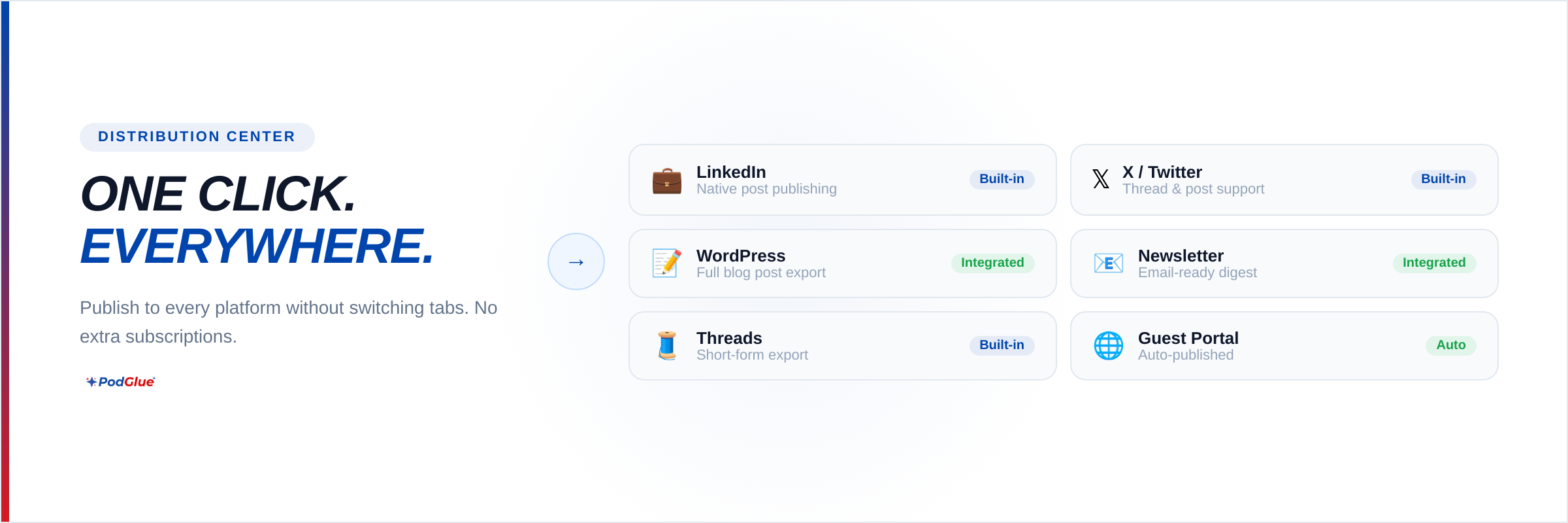
PodGlue has a Social Lab that reads your episode transcript and generates ready-to-publish content across every platform — LinkedIn posts, Instagram captions, newsletters, blog articles, carousel posts. All of it, automatically. And then you can schedule it directly from inside the platform to LinkedIn, Twitter, Instagram, and Threads without ever leaving PodGlue.
I immediately asked the question every content strategist would ask: "Can I add it to a queue? Because my whole thing is — they post it once and then they forget. That doesn't mean you can't post it six weeks later, eight months from now."
Junaid pulled up a full scheduling calendar. Yes, you can queue it. Yes, it pulls the content already generated for that episode automatically. Yes, it posts the text and the episode image together.
PodGlue monitors your RSS feed the same way Apple and Spotify do. The moment you publish, it grabs the episode, transcribes it, creates all the assets, and queues them up. You review and approve. That's it.
And it's not generic AI output. During onboarding, PodGlue walks you through six prompts — you run them through your AI tool of choice, Claude, Gemini, whatever — and it generates your personal voice guide, your brand style guide, your ideal client profile. All of that gets uploaded into your workspace so every piece of content sounds like you. There's even a list of 150–200 banned words and phrases baked in by default. No more "enthralling" or "game-changing" showing up in your posts uninvited.
Feature #3: The Partner Access Portal — Make Your Guest Feel Like a VIP
Think about the last time you were a guest on a show. You probably got a DM a week later with a Dropbox link and maybe a JPEG you weren't sure how to use. That's the standard. PodGlue makes that look embarrassing.
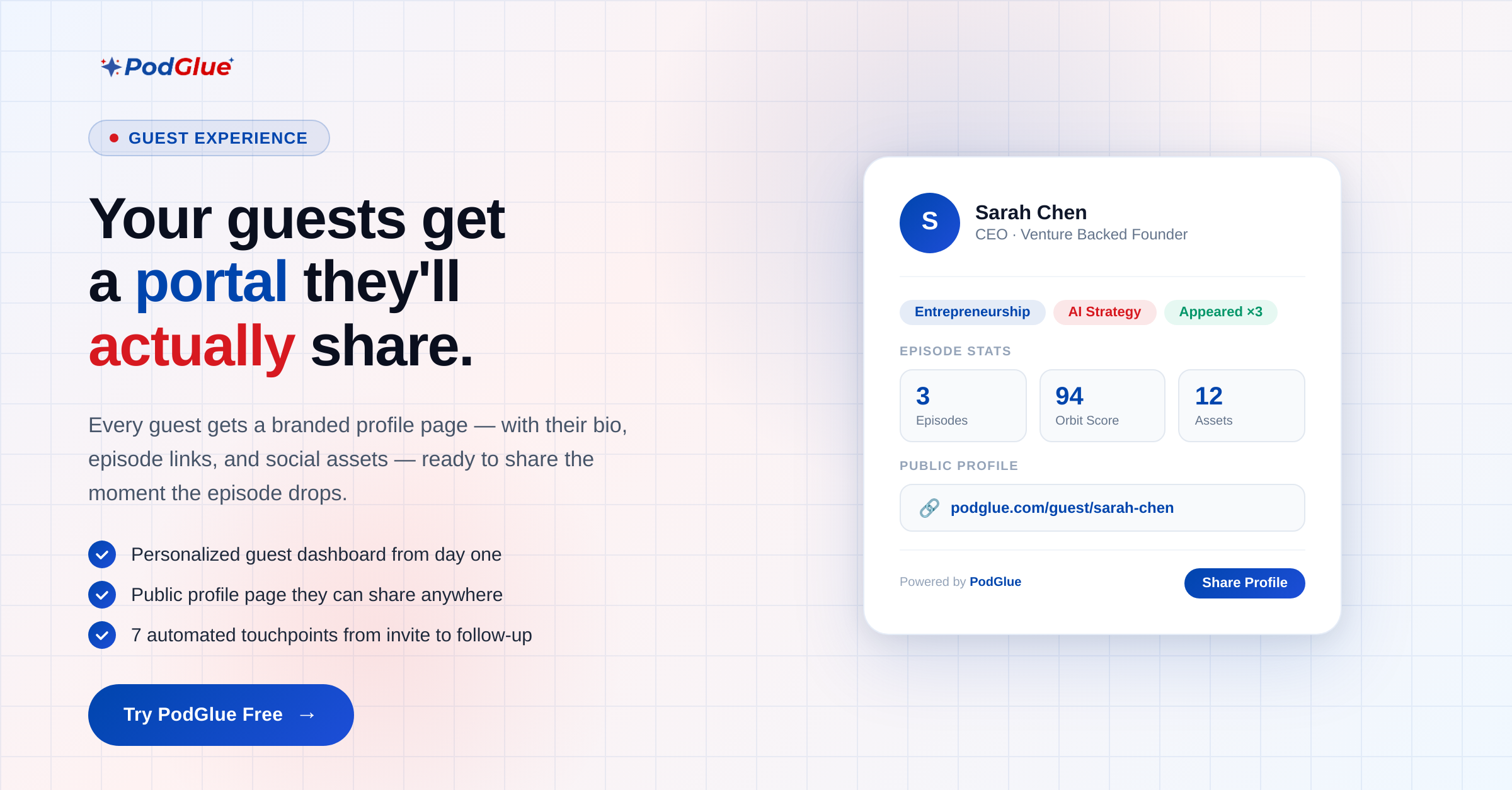
When a guest receives their Partner Access Portal link, they land on a page built entirely for them. They can listen to their own episode. They get shareable images already generated. Pull quotes ready to download and post. A media section where I can drop in anything — video clips, a Google Drive folder, resource links — and it all shows up clean and organized.
But here's what makes it more than just a nice guest experience: it's a growth loop. As guests share their portal, and their audience starts clicking and asking what is this PodGlue thing? — those people become leads. And with guest.podglue.com coming soon, guests will be able to build their own full profiles, turning a single episode into an ongoing credential inside the PodGlue ecosystem.
It also functions as a media kit — automatically. When agencies or event organizers ask a guest to "send their media kit," they now have one. Built by the episode. No extra step for anyone.
Feature #4: The Network Graph — Relationship Intelligence Nobody Else Has
This is the feature that made the live stream audience lose their minds — and honestly, me too.
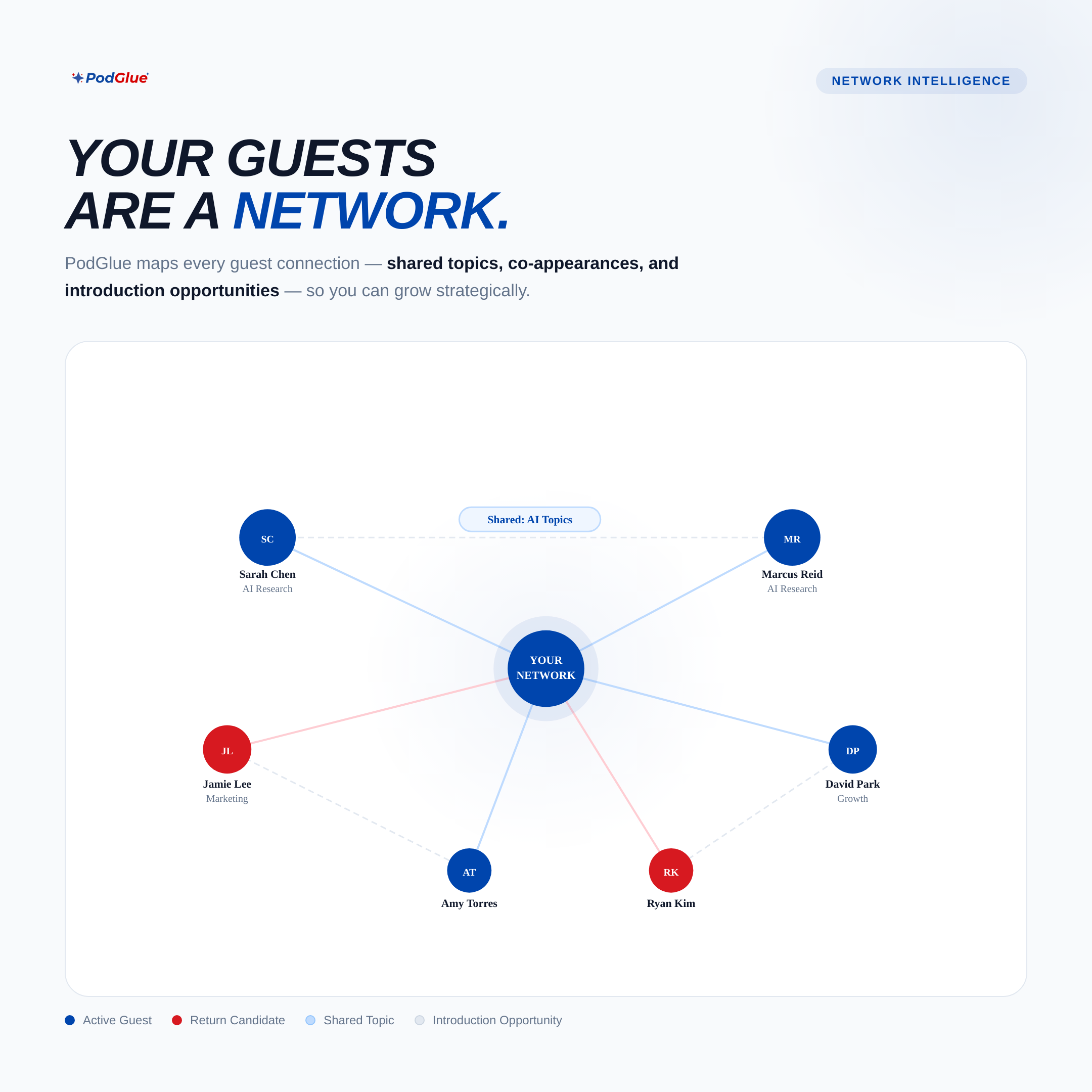
PodGlue builds a visual network graph of every guest relationship you have. Who's connected to who. What topics they share. How long since you last engaged. And it actively surfaces reconnect suggestions based on the data.
"I built something called a network to keep track of my relationship network," Junaid explained. "Who am I talking with? What's my follow-up? What's the relationship health with other people? Reconnect suggestion with these two people — because you talked to them 2,541 days ago."
It even clusters guests by the topics they discussed on your show. So if six of your guests all talked about heart-centered leadership, PodGlue groups them together. You can then bring all six back for a panel, a summit, or a collab series — because the system already knows they're aligned.
"Six degrees of Kevin Bacon," Junaid said, grinning. And then he showed me exactly that — a web of guests connected through shared conversations and ideas.
I immediately thought about virtual summits. "If you were to say, 'Hey, let's get this cluster of people' — it would be cool to say they all fall underneath the same umbrella. It'd be nice to have them all as different speakers for an event — because you already vetted them."
Junaid didn't disagree.
Feature #5: The Book Builder — Turn Your Episode Backlog Into a Published Book
I did not see this coming.
Junaid mentioned almost casually that he'd already written a book by taking 10 episodes from his podcast and converting them into chapters. Then he said: "Lo and behold, you've got something called a book builder."
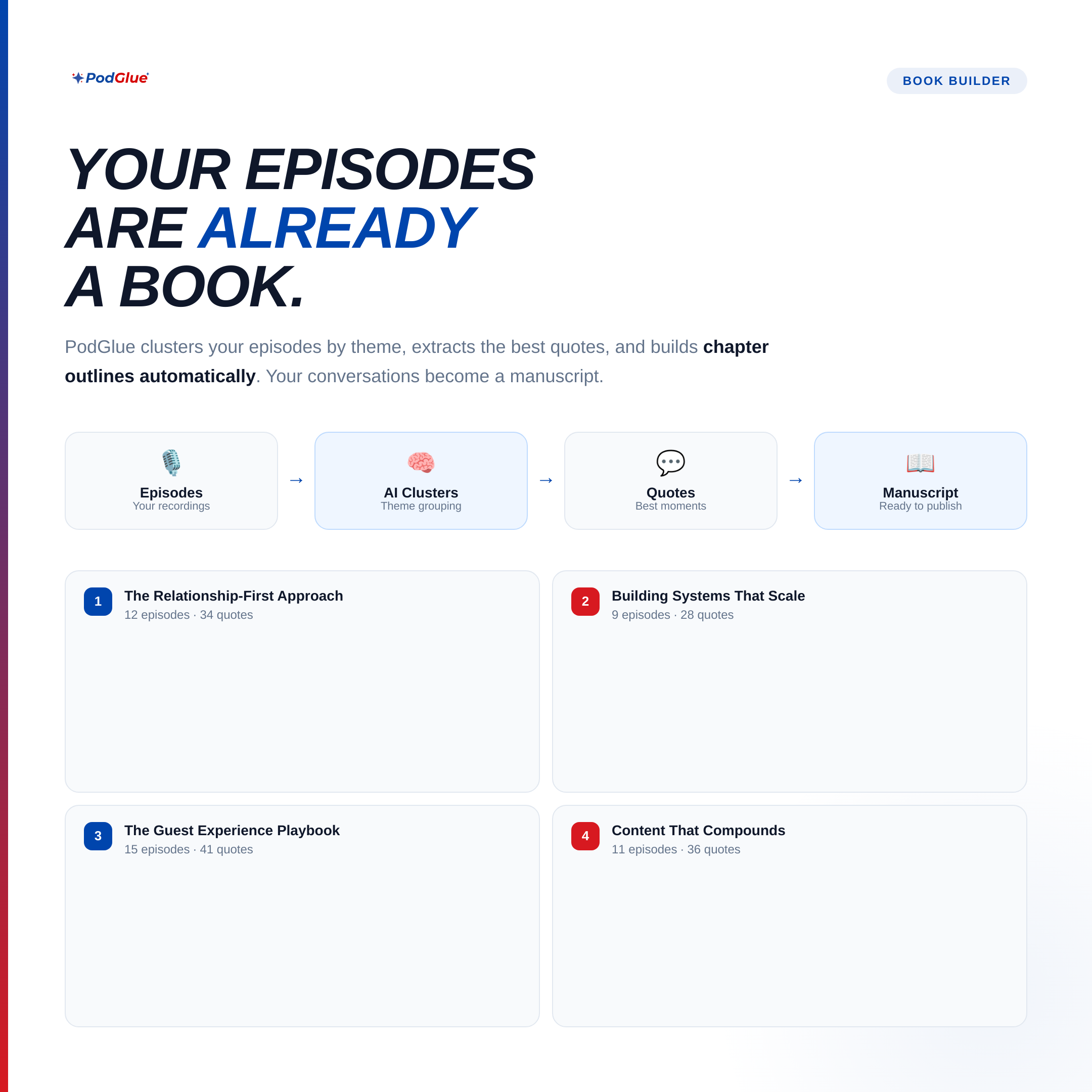
You pick a theme. PodGlue pulls the relevant episodes from your back catalog. It generates each episode as a full book chapter — in your voice, using the AI configuration you set up during onboarding. It writes a synthesized narrative thread to connect the chapters. It designs a cover. It generates the metadata for Kindle Direct Publishing. And it exports the whole thing as a PDF, EPUB, DocX, HTML, or Markdown file, ready to publish.
"It took the 7,000 words and generated a chapter in your voice," Junaid said as he walked me through one. A fully written, properly structured book chapter — from a podcast episode — in minutes.
Every podcaster who's been meaning to write a book but hasn't had time just had their excuse removed.
Feature #6: The Introduction Engine — Built-In Matchmaking
This one snuck up on me, but it might be one of the most relationship-forward features in the whole platform.
PodGlue lets you introduce two guests to each other — and it does most of the work. You select the two people, it logs the introduction, and then when you click "send intro email," it generates three different pre-written email options. Warm introduction. Collaboration opportunity. Custom.
I'd just been saying on stream how I love playing matchmaker — "Hey, Junaid, you should meet James" — but drafting that email is always a small friction point that stops it from happening. PodGlue removes it entirely.
Feature #7: Built-In Guest Booking — Goodbye, Calendly
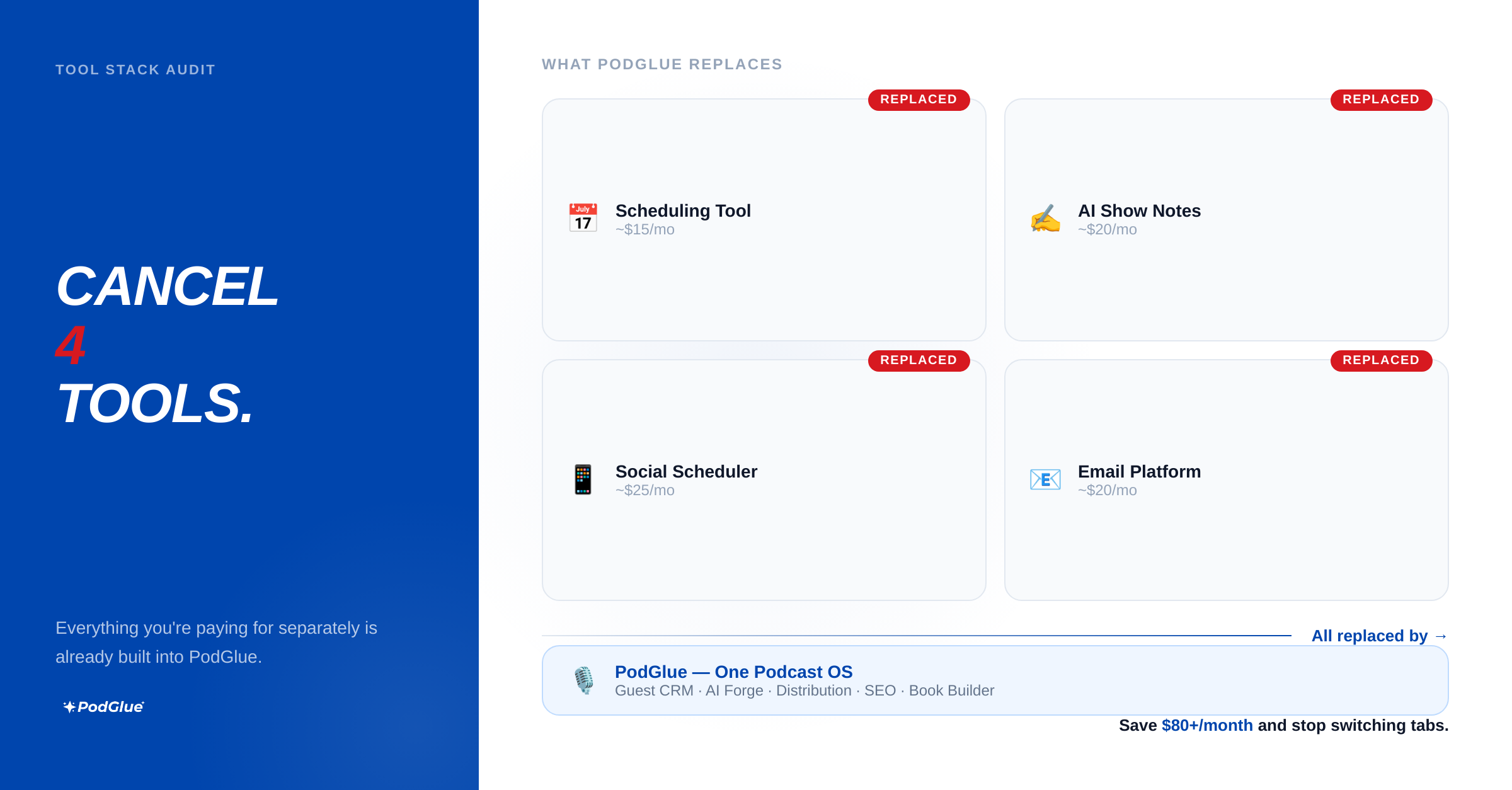
Booking guests is another one of those things that involves more tools than it should. PodGlue has Google Calendar integrated directly, with a built-in booking page that works just like Calendly — guests pick a time, fill out a form, and it flows straight into the system.
"You just put, like, a bunch of SaaS tools that I was using just on the chopping block," I told Junaid.
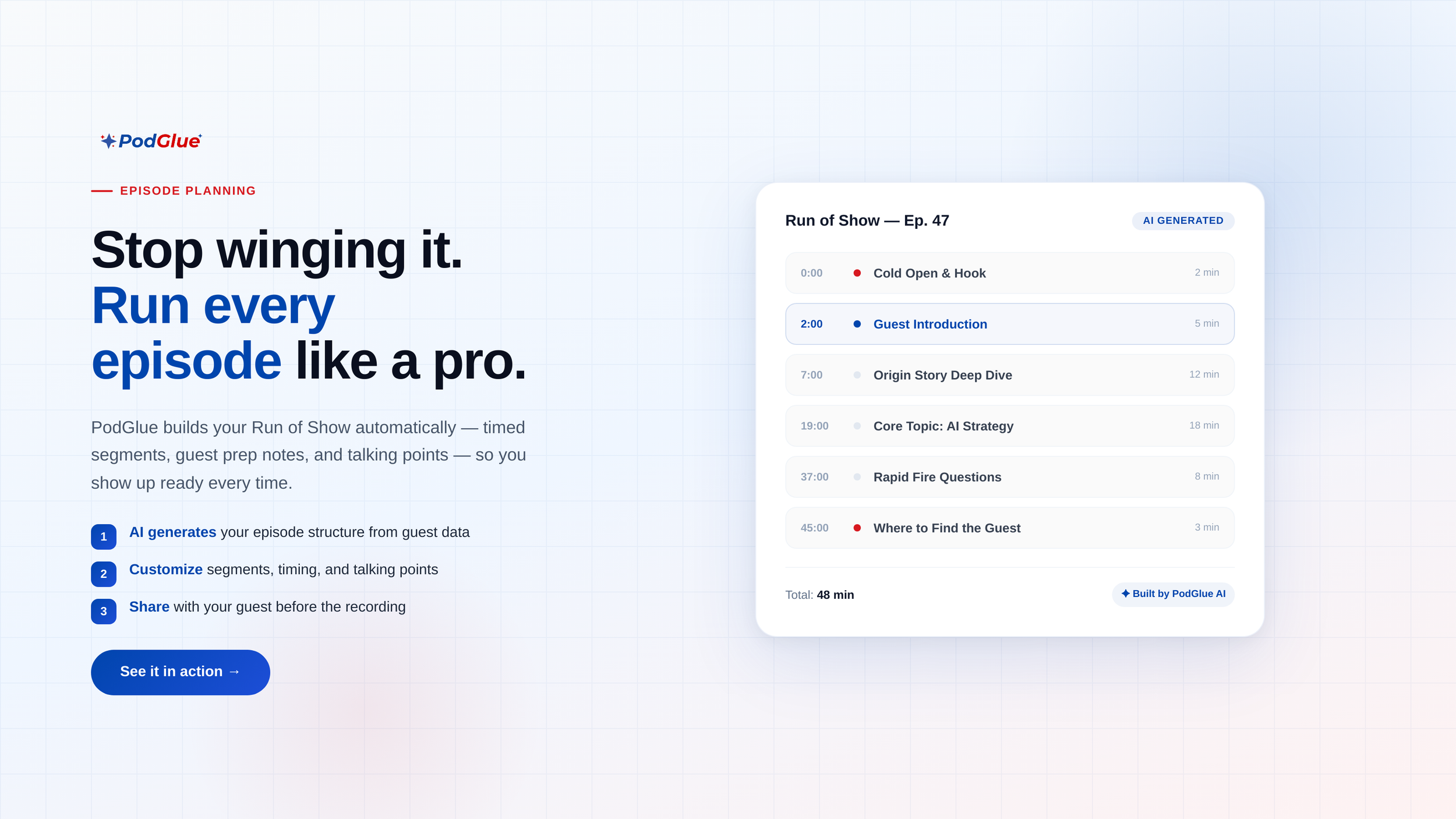
He didn't argue. Because he built this for himself first — to stop jumping between Calendly, a run-of-show generator, a CRM, and a scheduling tool just to get one guest booked and prepped.
Now it's one page. One form. One flow.
Feature #8: PR Pass — Press Release as a Service
When I suggested Junaid send a press release ahead of his May 22nd launch, he looked at me like I'd handed him a product requirement.
"I'm calling it a PR Pass — a press release as a service kind of feature," he said. "As you're bringing in guests, we'll create a press release kit for them which includes all the things you need to submit to a PR firm."
Distribution credits. Wire services. EIN, PR Newswire. Tiered, inside PodGlue.
The PR Pass is coming. It's not live yet. But the product requirements document exists, and if the rest of PodGlue is any indication, it won't be long.
Feature #9: Recording Studio + Teleprompter — Solo Podcasting, Built In
Toward the end of the demo, Junaid mentioned — almost as a footnote — that PodGlue has its own recording studio built in.
"You made your own recording studio in PodGlue?" I asked.
He had. And it's not just for recording. He built a teleprompter directly into it — because he's been wanting to start a solo podcast for years and kept getting stuck on needing to remember his talking points mid-recording.
Now he pulls up his episode outline, hits record, and the prompts scroll as he talks. No external teleprompter app. No switching windows. It's all inside PodGlue, which also has a production station to track each episode's stage in the pipeline and an idea bank for episodes not yet in production.
"Any problem that I saw that I was thinking about," he said, "I was like, let me just pop it in here."
The Case I'm Making
I've been in marketing long enough to know when something is genuinely different and when something is just well-packaged.
PodGlue is genuinely different.
Junaid's been building in stealth since December. He interviewed 100+ podcast hosts and 15 agency owners before writing a line of code. He wrote the philosophy book first, then built the software to implement it. The product has 15 setup guides already written, training videos in production and is planning weekly office hours starting at launch.
And this is, in his words, only 50% of what PodGlue does.
The Bottom Line
May 22, 2026 is the soft launch. Junaid's goal is 1,000 users in three to six months. And based on what I saw, I'd bet on him.
If you're a podcast host tired of the post-publish scramble, tired of relationships going cold after recording, tired of your content collecting digital dust — go check it out.
Join the waitlist at podglue.com or get an invite code from an existing user to skip the queue.
Don't sleep on this one.
Frequently Asked Questions About PodGlue
What is PodGlue? PodGlue is an all-in-one podcast relationship management platform — or PRM — built to handle everything that happens after you hit publish. Guest portals, social content creation and scheduling, relationship tracking, book building, guest booking, press releases, and soon native podcast hosting. Built by Junaid Ahmed, launching May 22nd, 2026.
What does PRM mean? PRM stands for Podcast Relationship Management — a term coined by Junaid Ahmed. The philosophy is that podcasts are relationship engines, not content machines. PodGlue is the software implementation of that philosophy, helping hosts maintain and grow the relationships built through every episode.
What is a podcast guest portal? A podcast guest portal is a dedicated page generated for each podcast guest that contains everything they need to promote their episode — shareable images, pull quotes, the episode audio, links, and any additional assets the host wants to include. PodGlue builds one automatically for every episode and also functions as a media kit.
What is the PodGlue Social Lab? The Social Lab is PodGlue's content creation and scheduling engine. It reads your episode transcript and automatically generates LinkedIn posts, Instagram captions, newsletters, blog articles, and carousel posts — all in your brand voice. You can then schedule directly to LinkedIn, Twitter, Instagram, and Threads from inside the platform. It's triggered automatically when you publish to your RSS feed.
How is PodGlue different from Podcastle or Descript? Podcastle and Descript are recording and editing tools focused on production. PodGlue focuses on everything after the episode is published — relationship management, content distribution, guest portals, social scheduling, book building, and audience data. They solve different stages of the podcast workflow and can be used together.
What is the PodGlue Book Builder? The Book Builder takes your podcast episodes and converts them into book chapters — in your voice, using your brand configuration. You select a theme and relevant episodes, and PodGlue generates chapter content, a narrative thread connecting them, a cover design, and KDP metadata for Amazon publishing. The finished manuscript can be exported as PDF, EPUB, DocX, HTML, or Markdown.
What is the PodGlue Network Graph? The Network Graph is a visual map of your guest relationships — who's connected to whom, what topics they share, how long since your last engagement, and relationship health scores. It surfaces reconnect suggestions and clusters guests by shared topics, so you can identify potential collaborations, panels, or summit speakers from your existing network.
What is the PodGlue PR Pass? The PR Pass is an upcoming feature that automatically generates a press release kit for each episode and guest. Hosts can purchase distribution credits to send those press releases through wire services like EIN or PR Newswire directly from the platform, without a PR agency.
Does PodGlue have an affiliate program? Yes. Every PodGlue user automatically receives a unique invite code that doubles as an affiliate link with payout tracking and shareable creative assets. No separate application required — every user is an affiliate from day one.
Who is PodGlue built for? PodGlue is built primarily for independent podcast hosts who want to manage guest relationships, automate content creation, and get more leverage from every episode. It also serves podcast agency owners managing multiple shows, and enterprise content teams using podcasting as part of a broader PR and content strategy.
Can PodGlue be used for virtual summits or conferences? Not officially yet — but the infrastructure is already there. The network graph, guest press kits, affiliate links, and shareable assets could all be repurposed for event speakers. Junaid confirmed it would be a relatively simple extension. Watch this space.
How do I sign up for PodGlue? Visit podglue.com to join the waitlist, or use an invite code from an existing user to skip the queue. You can also find Junaid at superjunaid.com or @SuperJunaid on any platform.
